
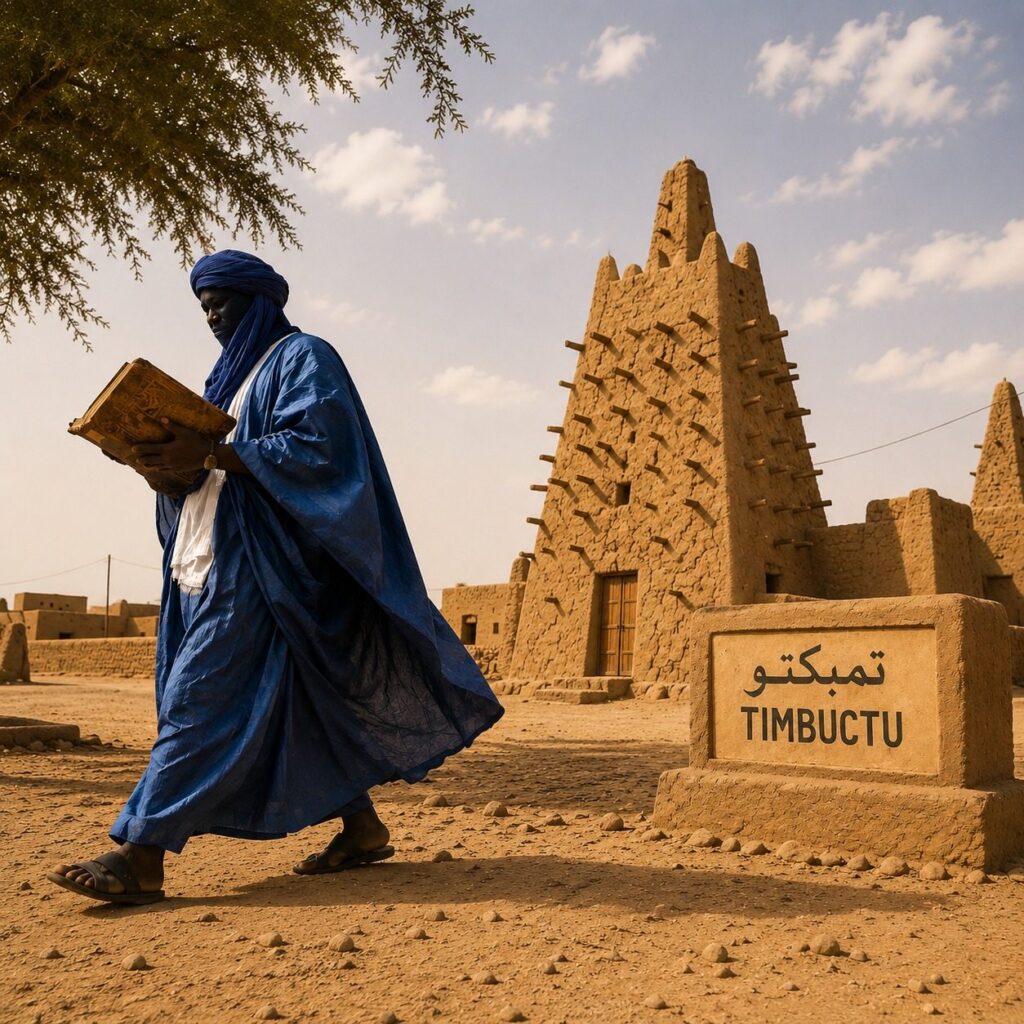
BAYT AL-HIKMA · TIMBUKTU · THE UNBROKEN THREAD
Timbuktu: Intellectual Capital of Sub-Saharan Africa
Long before the word “university” had settled into the European mind, Timbuktu was already a city of scholars. Its libraries were not curiosities or royal hoards — they were living institutions, passed from generation to generation within families who understood manuscripts to be sacred inheritances, as weighty as land.
Key Figures
| 25,000 | 700,000+ | 40+ |
| Students at Sankore at its peak | Manuscripts surviving into modern times | Books authored by Ahmad Baba alone |
Sankore Madrasah · University of the Sahel
12th – 17th centuries CE · Timbuktu, Mali
The university that the world forgot
The Sankore Madrasah grew from a mosque founded in 989 CE and by the 12th century had become something far larger than a place of worship. It was a confederation of independent colleges, each anchored by a master scholar who granted authorisation to teach only after years of rigorous study. The highest degree — equivalent to a doctorate — took a decade to earn and required an original written work, the Risaleh. Graduates were recognised across the Muslim world.
Subjects ranged across theology and law, but the curriculum was not narrowly religious. Mathematics, astronomy, medicine and surgery, philosophy, geography, chemistry, and linguistics all had their place. Students also trained in trade and craftsmanship — carpentry, navigation, agriculture, tailoring — because Sankore understood that the life of the mind and the life of the market were not enemies.
Theology & Law • Mathematics • Astronomy • Medicine & Surgery • Philosophy • Geography & History • Chemistry & Physics • Trade & Navigation • Language & Linguistics
“Many Timbuktu scholars possessed personal libraries of hundreds or thousands of books. Masters delivered authorisation to teach specific texts to their students — the prestige of the authorisation depended on the pedigree of the scholar.”
— Ousmane Oumar Kane, Beyond Timbuktu
The scholars who made it possible
Timbuktu was not sustained by one genius but by a culture of learning so deeply embedded in the city’s fabric that scholarship became hereditary. Families competed for the honour of hosting the most distinguished students. Libraries were dowries and inheritances. To have your son taught by a famous master was a mark of social standing that gold alone could not purchase.
Ahmad Baba al-Timbukti
Last Chancellor of Sankore. Grammarian, philosopher, author of over forty works. His personal library held 1,600 volumes. Exiled to Morocco in 1591; his captors reportedly marvelled at his erudition.
Mahmud Kati
Chronicler and historian whose Tarikh al-Fattash documented the Songhai Empire with the precision of a modern archivist. He recorded a meteor shower in 1593 with the detached eye of a natural philosopher.
Al-Qadi Aqib ibn Mahmud
Chief judge of Timbuktu who founded the Sankore Mosque in 989 CE — the seed from which the university grew. A wealthy Mandinka woman funded its full institutional development.
Ibn Yunus (via Timbuktu)
The Egyptian astronomer’s tables were copied and taught in Timbuktu. Surviving pages dense with star data prove that the city tracked the heavens with the same tools as Cairo and Baghdad.
What the manuscripts contain
The surviving manuscripts — estimated at several hundred thousand, the precise total still unknown — range from short private letters to multi-volume legal encyclopaedias. Scribes in Timbuktu translated Plato, Hippocrates, and Avicenna. Local authors wrote original treatises on Islamic jurisprudence, the movement of stars in relation to the Islamic calendar, and therapeutic properties of desert plants. One volume documented meteor showers with the eye of a scientist.
The manuscripts were written primarily in Arabic — the lingua franca of Islamic scholarship — but also in local languages rendered in Arabic script: Fula, Songhay, Tamasheq, Bambara, Soninke. Africa was not consuming knowledge from elsewhere and leaving no trace of itself. It was producing knowledge in its own languages, in its own voice.
The city through time
989 CE
Al-Qadi Aqib founds the Sankore Mosque. A wealthy Mandinka woman funds its development into a centre of learning.
1324
Mansa Musa returns from Mecca, bringing architect Es Saheli who builds the mosques and academies that define Timbuktu’s skyline. European mapmakers begin to draw him on their charts — a Black sovereign equal to any Christian king.
12th–16th centuries
Golden age. Sankore enrols 25,000 students. Private libraries proliferate. Timbuktu becomes the intellectual capital of sub-Saharan Africa.
1591
Moroccan invasion. The Songhai Empire falls. Ahmad Baba is exiled to Marrakesh. The city begins its long intellectual decline, though libraries survive in private hands for centuries more.
1893
French colonial rule. Arabic education is systematically marginalised. Manuscripts are sold off piecemeal.
2012–13
Islamist occupation. The greatest threat in centuries to a record that had survived invasion, drought, and colonial erasure.
The Crisis of 2012
When Ansar Dine seized Timbuktu, the world feared the destruction of one of humanity’s irreplaceable archives. 4,203 manuscripts were burned or stolen. But led by Dr. Abdel Kader Haidara and Stephanie Diakite, local families hid thousands of manuscripts in their homes, then smuggled approximately 350,000 of them to safety in Bamako — transported in footlockers, suitcases, and grain sacks, slipped past checkpoints in the dark.
Rescued & Digitised
~350,000 manuscripts evacuated south to Bamako, with 300,000 still in storage there as of 2022, awaiting proper conservation.
Over 150,000 manuscripts photographed by HMML since 2013, now accessible through their online Reading Room — making Timbuktu’s knowledge globally reachable for the first time.
What the libraries mean
The Timbuktu manuscripts do not merely prove that Africa had a written intellectual tradition — they prove that it had one sophisticated enough to engage, on equal terms, with the great questions that occupied scholars from Baghdad to Córdoba to Cairo. They contain original thought, not just transcription. They contain dissent, not just orthodoxy. They contain science conducted through observation of the actual sky above the actual Sahara.
What was lost when the French marginalised Arabic education was not just a collection of old books. It was a living epistemology — a way of knowing the world that had been developed and refined across six centuries, rooted in this particular landscape, these particular peoples, these particular questions. The manuscripts that survive are what remain of that conversation, waiting to be heard.
“It is traditional for a family member to swear publicly that he will protect the library for as long as he lives.”
— On Timbuktu’s manuscript custodians
Bayt al-Hikma Series · The Unbroken Thread of Islamic Learning