Baghdad, 9th Century
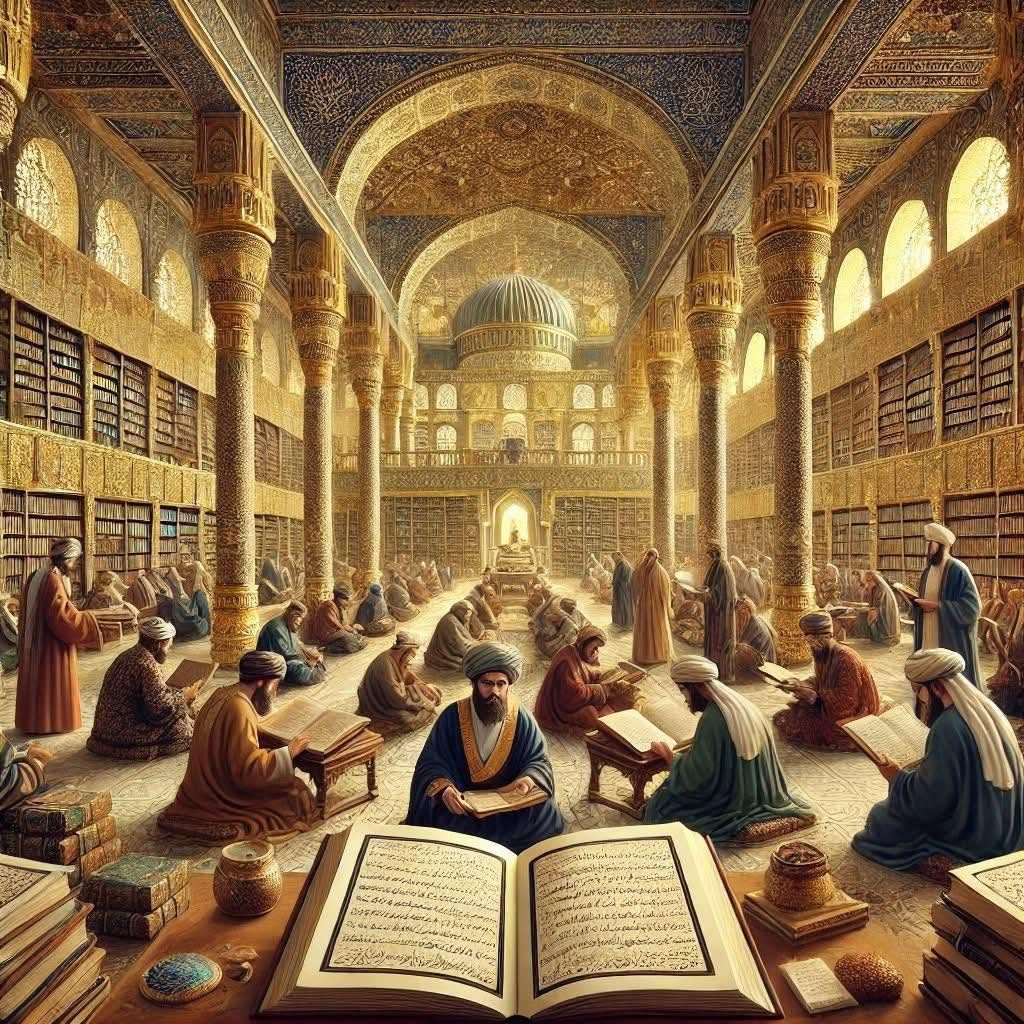
At its height, Bayt al-Hikma was not merely a library — it was a civilisation’s metabolism, the organ through which the Abbasid caliphate digested the inherited wisdom of Greece, Persia, and India and transformed it into something entirely new. Caliph al-Ma’mun, who founded the institution in its mature form around 830 CE, understood what many rulers before and since have not: that power without knowledge is fragile, and that the accumulation of ideas is the most durable form of conquest.
Scholars arrived from every corner of the known world. Christians translated Galen and Hippocrates into Arabic. Jewish scholars carried Talmudic logic into dialogue with Aristotle. Zoroastrian astronomers brought Persian star tables that dwarfed anything the Greek tradition had preserved. And Muslim mathematicians — al-Khwarizmi above all — synthesised all of it into entirely new disciplines. The word algebra is his. So, in a manner, is the word algorithm.
“The caliph reportedly dreamed of Aristotle and awoke resolved to own every word the philosopher had ever written — in Arabic.”
The translation movement was never passive. When Hunayn ibn Ishaq rendered Galenic medicine into Arabic, he did not simply copy; he corrected errors, collated manuscripts, and wrote original commentaries that the Greek originals had not prompted. Al-Kindi applied Aristotelian logic to Islamic theology, al-Farabi placed Plato and the Prophet in philosophical conversation, and Ibn al-Haytham set aside the intuitions of both in favour of a radical idea: that knowledge of the physical world must be earned through systematic experiment and observation. The telescope that Galileo pointed at Jupiter’s moons was, in a real intellectual sense, descended from the darkened room in which Ibn al-Haytham had bent light through a pinhole and measured what he saw.
The scholars who built the bridge
Al-Khwarizmi
Mathematics, astronomy. Gave the world algebra and the decimal positional system.
Hunayn ibn Ishaq
Medicine, translation. Rendered Galen into Arabic with critical commentary.
Al-Kindi
Philosophy, optics. First philosopher of the Islamic world; wrote on cryptography.
Ibn al-Haytham
Optics, scientific method. His Book of Optics preceded Kepler by six centuries.
The journey westward
Knowledge does not stay where it is made. By the tenth century, the same river of learning that flowed through Baghdad had reached Córdoba, where the Umayyad caliphate had built a rival library said to hold four hundred thousand volumes — more books than existed in all of Christian Europe at the time. It was here that Ibn Rushd — Averroes to the Latins — wrote his great commentaries on Aristotle, commentaries so definitive that for centuries European scholars simply called their source “the Commentator,” as though no other deserved the name.
c. 830 CE
Al-Ma’mun establishes Bayt al-Hikma in Baghdad; systematic translation programme begins under state patronage.
c. 1000 CE
Córdoba under the Umayyads becomes the western twin of Baghdad — a second pole of the intellectual world, drawing European scholars southward across the Pyrenees.
c. 1120 CE
Adelard of Bath returns to England with Arabic manuscripts: Euclid’s Elements, astronomical tables, works on natural philosophy — the seed-packet of the European scientific revolution.
1258 CE
The Mongol sack of Baghdad ends the Abbasid caliphate. The Tigris is said to have run black with ink from the libraries thrown into it. But the knowledge was already gone — westward, into the hands of those who would build on it.
This is what Jonathan Lyons understood when he titled his book The House of Wisdom: How the Arabs Transformed Western Civilization. The story is not one of a golden age sealed behind glass, mourned in hindsight. It is the story of how ideas move — across languages, across faiths, across the borders that politics draws and scholarship quietly ignores. Adelard of Bath did not travel to the Arab world because he was told to. He went because he was hungry, and the only feast was there.
“The Arabic language was, for two centuries, what English is today: the universal medium through which the educated spoke to one another across every frontier.”
The deeper lesson of Bayt al-Hikma may be less about what was produced than about the conditions that made production possible. Al-Ma’mun’s court was not tolerant of diversity by accident or inertia — it was tolerant as a policy, because the caliph understood that a closed mind is a closed institution, and a closed institution cannot grow. Muslim and Christian and Jew sat at the same table, in Baghdad and in Andalusia, not because they had resolved their theological differences, but because the questions they were asking together were larger than the answers any of them held alone.
That spirit — curious, porous, unafraid of what the other tradition might know — is the true inheritance of the House of Wisdom. Not the algebra, though we use it daily. Not the astronomical tables, though they guided Columbus. The inheritance is the method: the conviction that knowledge belongs to no single civilisation, that every wall built around it diminishes it, and that the accumulated light of every culture, translated patiently into a common tongue, is brighter than any one flame burning alone.